Tuesday, 5 April 2011

Sally Apfelbaum ( for theme 1)


Also in this book (Contemporary Photography And The Garden) I looked at the work of Sally Apfelbaum, a landscape artist recognised for her fresh and complex intrepretations of the natural world. I also looked at her work on line:  Untitled Document - Sally Apfelbaum

                                                                 by Sally Apfelbaum

 by Sally Apfelbaum

Again these sort of images look dreamy, but in a different way to those of Linda Hacketts, they are not all totally blurry.  I think I have always been drawn to these type of dreamy looks in photographs, but I have only just realised ....  as I look around the room that I sit in typing this,  there are 3 pictures on the wall, all of which have dreamy looks  and feel about them (I may take pictures of these pictures to include here too).

These sort of images can look like paintings with the colours and the way the blur comes in just here and there.  I think there are focus points in the above scene, it looks to be to the middle right where the water looks clear as the reflection.  The colours make it look like an old painting, where as in the top most image the colours make a more up to date look to the scene.  Lines guide the eye up into the scene in both images from the path in the top image to the water way in the above one, and the angle they are taken from shows these guide lines on the diagonal, starting from the bottom left foreground leading up diagonally through the scenes.  Different sized objects are looked at in both scenes from the small of the flowers, ranging up to the taller bushes then the taller of the trees in the top image (depicts scale).  Then in the above scene the scale is showing from the flat of the water, ranging up to trees in the middled ground and up higher still to those in the clouds, and upwards higher to that of the clouds themselves, in the background.  So in this Sally Apfelbaum appears to be following a theme showing the scales of nature.  I think also here we have old and new, the new being the top scene.  The old is where we can see the objects are taller overall and in the new scene, the things are overall smaller,  maybe to mean that in nature things get shorter, smaller or flattened over time.   Both scenes are of a 50/50 balance too, in that the majority of detail and colour is confined to the bottom half of the images, leaving lighter and somewhat sparcer detailing to the top halves.

Sally took this image and the 2 below in Giverny, France while she was an artist in residence at the Monet Museum.  These images are made up of multiple exposures, where she used a compass and combined North, South East, and West views on a single image.  She is interested in the space of an image and its take on meaning, and also wants to include as much information as possible.

by Sally Apfelbaum


by Sally Apfelbaum

These 2 images on her web site can be zoomed into via the  '+'  buttons to view the close textures.   She uses differential focus with the placement of various structures, the horizon line, motion and colour combined through the layers to create a sense of depth and continuous space.

taken by Sally Apfelbaum

Again in this scene taken in Paris the majority of bold colours and objects in placed in the lower 50% of the scene, with the sky and clouds covering 50%, another half and half image.  Some digital manipulation is also present in this one I think to bring out the dramatics of the clouds and again it looks to be overlayed by more than one image, as there are people in the clouds, so this is a different throw on dreamy.  Three quite different colour ways show in these 3 scenes from the new cottage garden look, the the old painting scene, then the city colours, but all follow the 50/50 look of bold and heavy at the bottom.


Low Flight
Shutter 1/125 aperture f7.1 iso 200 focal L 105mm

Planning:  I planned to go to Calke to take shots of nature in the form of lake views,  hand held  with a Canon Eos 5D camera.  I ensured I had a full battery and clear flashcard before I set out, good walking footwear, mobile phone, umberella, just in case, and a couple of cereal bars.  I would not be taking the tripod knowing I would be working on unsteady ground (bank of the lake).
In the above shot I focussed on the lake and watched some colours seaping into the far background right from not too much of a low sun.  Then as if by magic, I got lucky to see the 2 birds having a majestic low flight accross the water, and centre focussed in on them, on a centre focus only mode which shows their brightness in a dim lit conditions.  This one does not hold great colours,   (I could enhance them slightly in Photoshop), but what it holds is the feel of nature for me.  The 2 birds gliding over the centre are paramount to the scene adding a softness and focal point to take the eye inward. They also give the scene movement and  I like their bright reflection in the water.  While they are not clear, they don't need to be to give the overall feeling of calm nature happening.
I have included this here comparing it to the above scene because it contains water, sky, darker colours and horizontal layers, ie.  in the front foreground bush layer to the light water layer (the reflections) to the dark water layer, the trees and colour layer then the top sky layer.  Similarly Sally Apfelbaum's image starts with a foreground dark water layer, to a reflected layer, to an objects colour layer, to an impressionistic layer, and another upper one, to the top cloud layer.  Also the reflections show down in hers from the sky to the water, as in mine, showing similar contrasts of light and dark.  I have not used multiple exposures to achieve my images though.


Spring Flight
shutter 1/32  aperture 7.1  iso 200  focal L 105mm

This gives a completely different look and feel to a lake side view.  It says "this is spring" to me with the bold colours and is in stark contrast to the above soft subdued lighting shot.  Here the sun was brighter, and a little higher in the sky, and I used a slower shutter to give blur to the birds and again was hand holding the camera. I was careful where I stook here on the bank, from a health and safety point of view (see blog Heath and safety Act) so as to not stand to close to the edge to slip and fall down the bank.  I then walked round and down to sit lower, on the yellow bank to take more shots at a lower angle with views up the lake, and again was careful with my footwork, because some of the pathway was quite narrow. I carried my camera equipment carefully over my shoulder, leaving both arms free just in case of  stumbling and walked gingerly.   I sat on the bank a while and waited for the sun to lower. When I did shoot I  kept the camera strap over my head and held the camera close and steady. My posture was that of one foot in front of the other to give steadiness on the bank.

  I have enhanced the colour slightly giving more radiance.   I was capturing the birds in mid air which gives a joyous feel to their  group gathering. I don't think it would have worked with just one or two birds, there had to be more in the scene to capture the effect.   I am trying to show, as with Sally Apfelbaum's, that different colours in similar scenes can give quite different feels and atmospheres.  Again it is not all clear, but Steve has told me not to be frightened of blur, and the blur here adds to the atmosphere I think.. the blur  of the birds gives a mystical look and the blur of the bank lends to what I am trying to achieve in part, that of a painting effect. 
 My glooming scene was taken from a lower angle than that of my bright scene, again comparing to Sally's bright new garden scene being taken from a higher angle than her darker water ones.

Whilst on this visit to Calke I also considered conservation issues (see blog Wildlife & Countryside Act) ie. I would be looking where I was walking so as not to step anywhere that would damage wildlife habitats.


What would I do differently next time....maybe I could have had my iso higher for 'Low Flight", though like I say  I could also lighten it post capture.

The Wildlife and Countryside Act


For my research into the principles of photo image capture, I have considered Health and Safety and conservation issues, taking information from their web sites:-


The Wildlife and Countryside Act 1981

The Wildlife and Countryside Act 1981 consolidates and amends existing national legislation to implement the Convention on the Conservation of European Wildlife and Natural Habitats (Bern Convention) and Council Directive 79/409/EEC on the conservation of wild birds (Birds Directive) in Great Britain (NB Council Directive 79/409/EEC has now been replaced by Directive 2009/147/EC of the European Parliament and of the Council of 30 November 2009 on the conservation of wild birds (codified version)).  Equivalent provisions for Northern Ireland are contained within the Wildlife (Northern Ireland) Order 1985  and the Nature Conservation and Amenity Lands (Northern Ireland) Order 1985 .

The Act received royal assent on 30 October 1981. It is supplemented by the Wildlife and Countryside (Service of Notices) Act 1985, which relates to notices served under the 1981 Act. Various amendments have occurred since the original enactment, some of the most significant being via the

There are also numerous country-specific Orders pertaining to Variation of Schedules of the Act.

In Northern Ireland legislative amendments have taken place through the Wildlife (Amendment) (Northern Ireland) Order 1995  and the Environment (Northern Ireland) Order 2002.

The original Wildlife and Countryside Act 1981 text is available and an updated version is available on Office of Public Sector Information website.

There is also a statutory five-yearly review of Schedules 5 and 8 (protected wild animals and plants respectively) and period review of Schedule 9 (in relation to non-native species).  These reviews are undertaken by the country agencies and coordinated by JNCC. Containing four Parts and 17 Schedules, the Act covers protection of wildlife (birds, and some animals and plants), the countryside, National Parks, and the designation of protected areas, and public rights of way.

Wildlife


The Act makes it an offence (with exception to species listed in Schedule 2) to intentionally:
  • kill, injure, or take any wild bird,
  • take, damage or destroy the nest of any wild bird while that nest is in use or being built (also [take, damage or destroy the nest of a wild bird included in Schedule ZA1] under the Natural Environment and Rural Communities Act 2006), or
  • take or destroy an egg of any wild bird.

Special penalties are available for offences related to birds listed on Schedule 1, for which there are additional offences of disturbing these birds at their nests, or their dependent young. The Secretary of State may also designate Areas of Special Protection (subject to exceptions) to provide further protection to birds. The Act also prohibits certain methods of killing, injuring, or taking birds, restricts the sale and possession of captive bred birds, and sets standards for keeping birds in captivity.

The Act makes it an offence (subject to exceptions) to intentionally ([or recklessly] - only under the Nature Conservation (Scotland) Act 2004) kill, injure or take any wild animal listed on Schedule 5, and prohibits interference with places used for shelter or protection, or intentionally disturbing animals occupying such places. The Act also prohibits certain methods of killing, injuring, or taking wild animals.

The Act makes it an offence (subject to exceptions)
  • to intentionally) pick, uproot or destroy:
    • any wild plant listed in Schedule 8, or
    • any seed or spore attached to any such wild plant (only under the Nature Conservation (Scotland) Act 2004));
  • unless the authorised person, to intentionally ([or recklessly] - only under the Nature Conservation (Scotland) Act 2004) uproot any wild plant not included in Schedule 8,
  • to sell, offer or expose for sale, or possess (for the purposes of trade), any live or dead wild plant included in Schedule 8, or any part of, or anything derived from, such a plant.

Animals and plants found on schedules 5 and 8 are listed on a spreadsheet of conservation designations for UK taxa.

The Act contains measures for preventing the establishment of non-native species which may be detrimental to native wildlife, prohibiting the release of animals and planting of plants listed in Schedule 9 (and any hybrid - only under the Nature Conservation (Scotland) Act 2004). It also provides a mechanism making any of the above offences legal through the granting of licences by the appropriate authorities.

Nature Conservation, Countryside and National Parks

The Act provides for the notification and confirmation of Sites of Special Scientific Interest(SSSIs) – these sites are identified for their flora, fauna, geological or physiographical features – by the country conservation bodies in England (Natural England) and Wales (the Countryside Council for Wales). (NB In Scotland similar powers are afforded to Scottish Natural Heritage under the Nature Conservation (Scotland) Act 2004 and in Northern Ireland the Council for Nature Conservation and the Countryside have powers under the Environment (Northern Ireland) Order 2002) to designate Areas of Special Scientific Interest (ASSIs).

A notification must be served on the relevant local planning authority, all land owners and occupiers, and the Secretary of State, specifying the time period within which representations and objections may be made. The country conservation bodies must consider these responses and may withdraw or confirm the notification, with or without amendment. The Act also contains measures for the protection and management of SSSIs. The Act provides for the making of Limestone Pavement Orders, which prohibit the disturbance and removal of limestone from such designated areas, and the designation of Marine Nature Reserves.


The Act prohibits the undertaking of agricultural or forestry operations on land within National Parks which has been either moor or heath for 20 years, without consent from the relevant planning authority. Planning authorities are also required to make available to the public up to date maps of moor and heath land within National Parks, which are important for the conservation of natural beauty.

May 2010

Thursday, 31 March 2011

Health & Safety at Work Act 1974


Health and Safety at Work etc Act 1974

The Health and Safety at Work etc Act 1974 , also referred to as HASAW or HSW, is the primary piece of legislation covering occupational health and safety in the United Kingdom. The Health and Safety Executive is responsible for enforcing the Act and a number of other Acts and Statutory Instruments relevant to the working environment.
The full text of the Act is available at the UK legislation website link to external website, where it can also be downloaded free of charge.
Statutory instruments are the secondary types of legislation made under specific Acts of Parliament. These cover a wide range of subjects, from control of asbestos at work, diving, escape and rescue from mines, ionising radiation and working at height.
If you need further advice on legal matters concerning the workplace, please contactHSE Infoline or consult Sources of information and external advisory services.

Disclaimer

The information on this site is regularly updated and checked for accuracy and completeness. However it is important to note that legal information must be used with a degree of caution.
Users must be aware that whilst an Act or Statutory Instrument (SI) may still be in force, parts may have been superseded by later legislation or completely withdrawn. If you use a printed or online version of an Act or Statutory Instrument this will generally be in the form that it was originally produced.
Any withdrawn or amended sections will still be contained within the Act or SI and there will be nothing in the document to identify those sections that no longer apply.
There are several solutions which you can try:
  • seek advice from HSE Infoline.
  • seek independent legal advice.

Wednesday, 30 March 2011

Research - Linda Hackett for theme 1


taken by Linda Hackett

                                                            Taken by Linda Hackett

I was looking at a book in college class ( Contemporary Photography And The Garden) and noticed some images by Linda Hackett.  They were blurry which gave a soft look with a dreamy sort of mood. There is a sense of  happy spring time in the above and its very colourful. The blur makes your eye search out things in the scene.  I decided to experiment with some blur and some focus in search of the dreamy look....

Linda Hackett is an American who started photographing an abandoned estate garden near her home in Southampton, New York in the mid 1980's.  She exaggerates colour and plant forms in her hallucinatory type imagery where elements of light and air take on an almost phisical presence.
She uses a pin hole camera which encompases extended exposure times to record the effects of wind movement through the garden.  She often places the camera so close to the subject that it would be unrecognisable without the written descriptive.  Hackett works exclusively at dawn and dusk when longer exposure times are required and adopts a "plants eye" perspective of the garden.  Her pin hole camera distorts light to give a metamorphosis mix of the light and intense colours resulting in the production of a surrealist atmosphere.

I have taken the following shots  in the garden at dusk in the shade.  I don't think the above was taken in any direct sunlight.  Here I am experimenting  firstly on smaller objects, to try to achieve a dream like effect, before I go out and try the full scene shots.  However I do not have a pin hole camera so will try to achieve the best I can with what I have.

shutter 1/6  aperture f4.0  iso 200  focal L 99mm

These 2 images contain some sky as in Linda Hackett's but not the same lovely blue.  I have included them because I like the curves of the twigs, but they don't have the appeal overall of Linda Hacketts, they don't really work the same.  Also these are where I have focussed in  a lot closer to the subject whereas Linda's  shot more of a full scene.

                                                shutter 1/25 aperture f4.0  focal L 105mm

I used a slow shutter speed and wide aperture which helped with the blur effect to the background and zoomed in to capture some detail.

shutter 0.4  f4.0  iso 200  focal L 105mm

The above image is better where sky is not included, I think it makes for a better composition and is more colourful because of the contrasts of the flowers to the dark green background.  Whilst the flowers are bright, they do look abit over exposed in parts, and  this loses detail, which could be ok here as I did not want all the details to be apparent anyway.

None of these images are completely blurred like that of Linda Hackett's which I think is not so easy to pull off successfully.  The sun was fading when I took this shot,  and no light was on the scene at all but because it had been a bright day and was now dusk, light still caught the flowers (above image) making them look bright. The dark shadows of the conifers gave the dark background.

                                                  shutter 1/25 f4.0  iso 200  focal L 75mm

The image above is more of a scene where I zoomed out abit.  I like it in part because it is unusual.  I think it captures dreamy slightly but it has hardness with the softness, given by the form of the tree trunks. In Linda Hackett's image the darkness on the left gives some drama and I wonder if the darkness here on the right achieves that.  What I do like is the triangle view of the sprigs, and it does make me think about the image more than my close shots above, which is what Linda Hackett's did.

                                              shutter 1/6  aperture f4.0 iso 200 focal L 105mm

The above is my completely out of focus image but it is only slightly so it still does not achieve the right effect.  I gained this all over out of slight focus by moving slightly as I took the shot hand held.  It has no dreamy quality and it left me wishing it was actually in full focus because I liked the colours and composition. 
 Again it is using hard and soft materials together and I had seen images that did this by another photographer in that same book, which I will look at again during class. 

 I took all these shots hand held thinking that any slight normal blur, by movement, may help what I trying to achieve.  If I was to attempt such shots again I could use a tripod and try tapping it as I released the shutter, but overall I think I need to use a slower shutter speed and move the camera around more.  I had had my camera set on a single centre focus point thinking this would also help make less of the scene in focus, but then I did focus with this centre point, in all but the last image, so this would not be the answer to achieve an overall blurry image either.


Other images I took:-
These images show some blur and some clarity in each just as my above ones do, hence still not achieving that overall blur look that looks correct.  However I do hope to capture the effect I am effect with digital manipulation later on:

                                                 shutter 4.0 aperture f4.0 iso 200 Focal L 105mm


shutter 1/8 aperture f4.0 iso 200 Focal L 75mm


                                             shutter 1/12 aperture f4.0 iso 200 Focal L 75mm


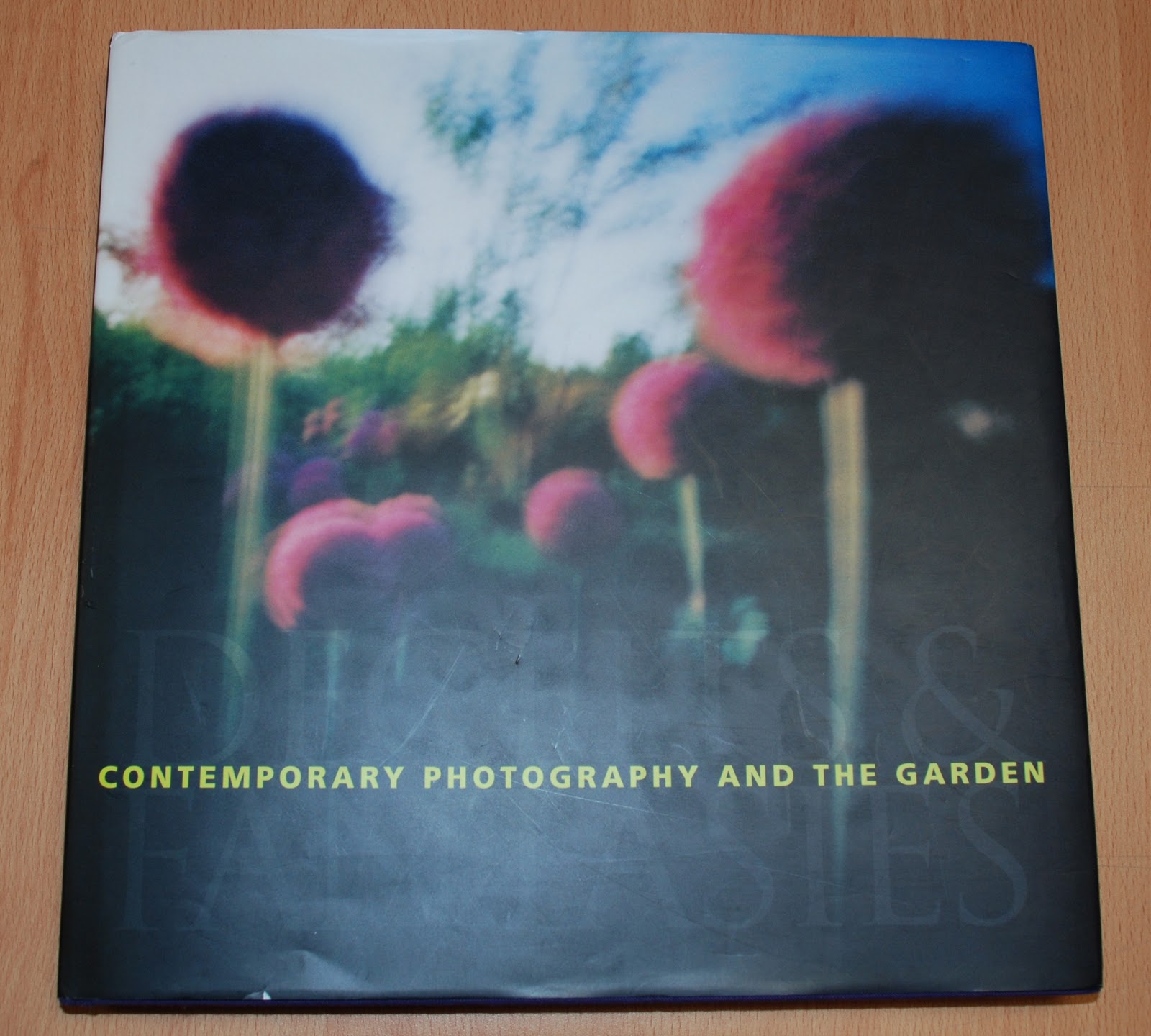
This is the cover of the book I have taken inspiration from in college class, Contemporary Photography And The Garden, Deceipts & Fantasies... where a group of artists in the mid 1980's turned to gardens as a subject for their photography.  It holds a wide range of artistic images whereby gardens are reflected upon as  sites of lyrical beauty and luxurient atmosphere to show them in a dark visual metaphor for the manipulation of nature.